ASCAP & BMI Music Licensing Guide for Businesses
Disclaimer: This article provides general information about music licensing in the U.S. and Canada. It is not legal advice. Licensing obligations vary by jurisdiction, business type, and use case. Please consult a qualified copyright lawyer or licensing expert.
If you play background music in your business—whether you run a gym, fitness studio, restaurant, café, hotel, spa, or retail store in the U.S. or Canada—you almost certainly need proper public performance licensing. In the U.S., the primary performance rights organizations (PROs) are ASCAP and BMI. These organizations issue “music licenses” that grant the right to publicly perform compositions and ensure songwriters, composers, and publishers receive royalties.
If your business isn’t correctly licensed, PROs may pursue enforcement, fines, and legal claims for copyright infringement. Beyond compliance risk, paying the right license supports the creators behind the music your customers hear.
That said, the world of music licensing is complex. Below, we present a refined, accurate guide—covering consent decrees, PRO comparisons, legal pitfalls, costs, and how B2B music services typically operate. For a turnkey approach, learn how Soundsuit works and explore our pricing.
What is the purpose of ASCAP and BMI?
ASCAP (American Society of Composers, Authors and Publishers) and BMI (Broadcast Music, Inc.) administer public performance rights. Their core role: when music is performed publicly (e.g., in a hotel lobby, restaurant dining area, gym floor, or retail store), the creators deserve compensation. Songwriters, composers, and publishers affiliate with a PRO so that when businesses play their works, royalties can be tracked and distributed. If your business plays music publicly, you must secure licenses from the relevant PRO(s) so you’re legally authorized—and so the creators are paid.
How PROs support music users (businesses)
To publicly play music, businesses need a Public Performance License (PPL). No matter the source—live band, streamed track, CD, vinyl, or digital file—it’s a public performance if it’s heard by customers or staff.
PROs act as intermediaries between the business (music user) and rights-holders (songwriters, publishers). Rather than negotiating with each artist individually, you buy a license that covers a catalog. The PRO collects your fees and distributes them to rights-holders. This model simplifies administration and ensures creators are compensated without requiring numerous individual contracts.
ASCAP vs. BMI (and SESAC / GMR): Catalogs & overlap
In the U.S., the main PROs are ASCAP, BMI, SESAC, and GMR—each with their own catalog of compositions. Creators can affiliate with only one PRO at a time, so catalogs don’t completely overlap. Because each PRO represents different works, a single license may not cover your full desired musical selection. Many businesses license ASCAP + BMI, sometimes supplemented with SESAC/GMR—or they use a B2B service that handles multiple PROs on their behalf.
Important legal nuances & consent decrees
Key points to understand:
• **Consent decrees & rate courts** – ASCAP and BMI operate under longstanding court orders that require they offer blanket licenses under regulated terms. Disputes over rates can be referred to a specialized “rate court.”
• **Public (small rights) vs. grand rights** – Blanket licenses cover public performance (small rights), not grand rights (e.g., musicals, dramatic works), which are negotiated separately with publishers.
• **Narrow exemptions** – Limited “home-style” or radio/TV rebroadcast exemptions may exist for very small establishments under strict conditions, but they’re narrow and vary locally. Relying on them without expert advice is risky.
Copyright infringement: when does it occur?
The creator or publisher holds the exclusive right to authorize public performances. Playing music publicly without a proper license constitutes infringement. PROs actively monitor and enforce compliance. If your business is found using music without a valid license, you may face statutory damages, fines, back-royalties, and injunctions.
How much do ASCAP and BMI cost to license?
PRO license costs vary by:
– Business type (hotel, gym, restaurant, retail, spa)
– Venue size, occupancy, speaker count, zones
– Number of locations
– Whether you play live music, DJ sets, or classes synchronized to music
– Whether you charge admission or cover fees
As a very rough benchmark, the lowest annual fees often start in the low hundreds of USD per PRO for small venues, with totals increasing as your footprint and usage grow. Managing multiple PROs directly means multiple bills and reporting. Many SMBs find bundled B2B solutions more predictable.
Can I stream Spotify / Apple Music if I pay PROs?
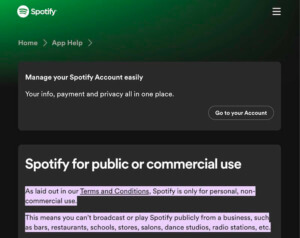
No. Consumer streaming platforms are licensed for personal, non-commercial use only. Even if you separately hold PRO licenses, they do not permit playback for business use in public areas. If you use downloads, CDs, or digital files, you still need PRO licensing and must ensure your songs are legally obtained and rotated to avoid repetition. For most SMBs, managing this manually is complex and error-prone.
When B2B music services may need add-ons
B2B music services simplify compliance and often reduce cost—but review edge cases:
– Live performances, cover bands, and DJ sets
– Fitness classes synchronized to music
– Admission fees / cover charges tied to music events
– Multiple zones or locations with differing usage patterns
– Catalog gaps if a provider doesn’t include a given PRO (e.g., SESAC)
Audit your actual usage (speakers, zones, live vs. recorded) and confirm in writing which PROs and use cases your provider covers.
Why many SMBs choose a licensed B2B platform
Business-focused music platforms can deliver:
• Bundled licensing coverage (fewer separate PRO contracts)
• Predictable monthly or annual pricing
• Curated, compliance-ready catalogs and explicit-content filters
• Scheduling, multi-zone, and reporting tools.
Want a compliant, hands-off setup? See
how Soundsuit works,
then choose a plan on our
pricing page.
FAQs for U.S. & Canada (ASCAP, BMI, SESAC, GMR, SOCAN, Re:Sound)
Do restaurants, hotels, gyms, and retail stores need a music license?
Yes. If your business plays music in public areas—lobby, dining rooms, gym floors, etc.—you’ll usually need a public performance license from applicable PRO(s).
Which PROs apply in the U.S.?
ASCAP, BMI, SESAC, and GMR. To cover a broad catalog, you may need to license multiple PROs or use a provider that bundles coverage.
What about Canada?
In Canada, SOCAN and Re:Sound manage public performance rights. If you have locations in Canada, confirm whether your provider includes these obligations.
Can I use Spotify or Apple Music in my business if I pay PROs?
No. Consumer streaming apps are licensed for personal use only and aren’t legal for business playback—even if you hold PRO licenses.
How do B2B music services help with compliance?
They bundle licensing, provide compliant catalogs, scheduling & zone controls, usage reporting, and reduce administrative workload. Always verify in writing which PROs and use cases are covered.
Soundsuit
Ready to elevate your business music?
Join 10,000+ businesses that use Soundsuit to play the right music, stay legally compliant, and boost customer experience.
Start your free trial