SACEM-Gebühren für Co-Working-Spaces

1. Einleitung
SACEM texts defined business premises as spaces reserved for employees of a company or administration, whatever their status (salaried employee, seconded employee, contractor, etc.), such as :
-
- Büros und Freiflächen ;
- Werkstätten und Fabriken
- Planungsbüros ;
- Lagerhäuser
- …
-
- die gesamte Beschallungsanlage der Einrichtung und ihrer Gemeinschaftsbereiche (Flure, Treppenabsätze, Aufzüge, Toiletten, Besucherempfangsbereiche usw.);
- Beschallung und musikalische Begleitung von internen Veranstaltungen (Meetings, Apéros, Meetups, Afterworks, verschiedene Events usw.), für die kein Eintrittsgeld erhoben wird;
- Beschallung und musikalische Begleitung kommerzieller Veranstaltungen, die intern organisiert werden (Werbeaktionen, Vorführungen, Produkteinführungen, kleine Messen usw.) und für die kein Eintrittsgeld erhoben wird;
- Beschallungsanlagen für bestimmte Bereiche, die den Mitarbeitern vorbehalten sind, wie Kantinen, Ruhe- und Entspannungsräume, Betriebskindergärten, Sport- und Fitnessräume usw.
- Beschallungsanlagen für den/die Firmenparkplatz/-plätze.
-
- Beschallungsanlagen und musikalische Begleitung bei Veranstaltungen außerhalb des Hauses;
- Beschallungsanlagen für Räumlichkeiten, Geschäfte und Verkaufsräume;
- Soundeffekte für die Website der Einrichtung;
- Beschallungsanlagen für alle im Unternehmen/Gebiet bereitgestellten Unterkünfte;
- Beschallungsanlagen für die Telefonanschlüsse des Unternehmens, für die die spezifischen Tarife gelten.
-
- die Anzahl der Arbeitsplätze in der Einrichtung (pro Standort)
- die Art und Anzahl der Musiksendungen.
In addition to this royalty, a related right, equitable remuneration, is collected by SACEM and redistributed to SPRÉ.
https://www.spre.fr/utilisateurs/autres-lieux-sonorises/
Theoretical amount:
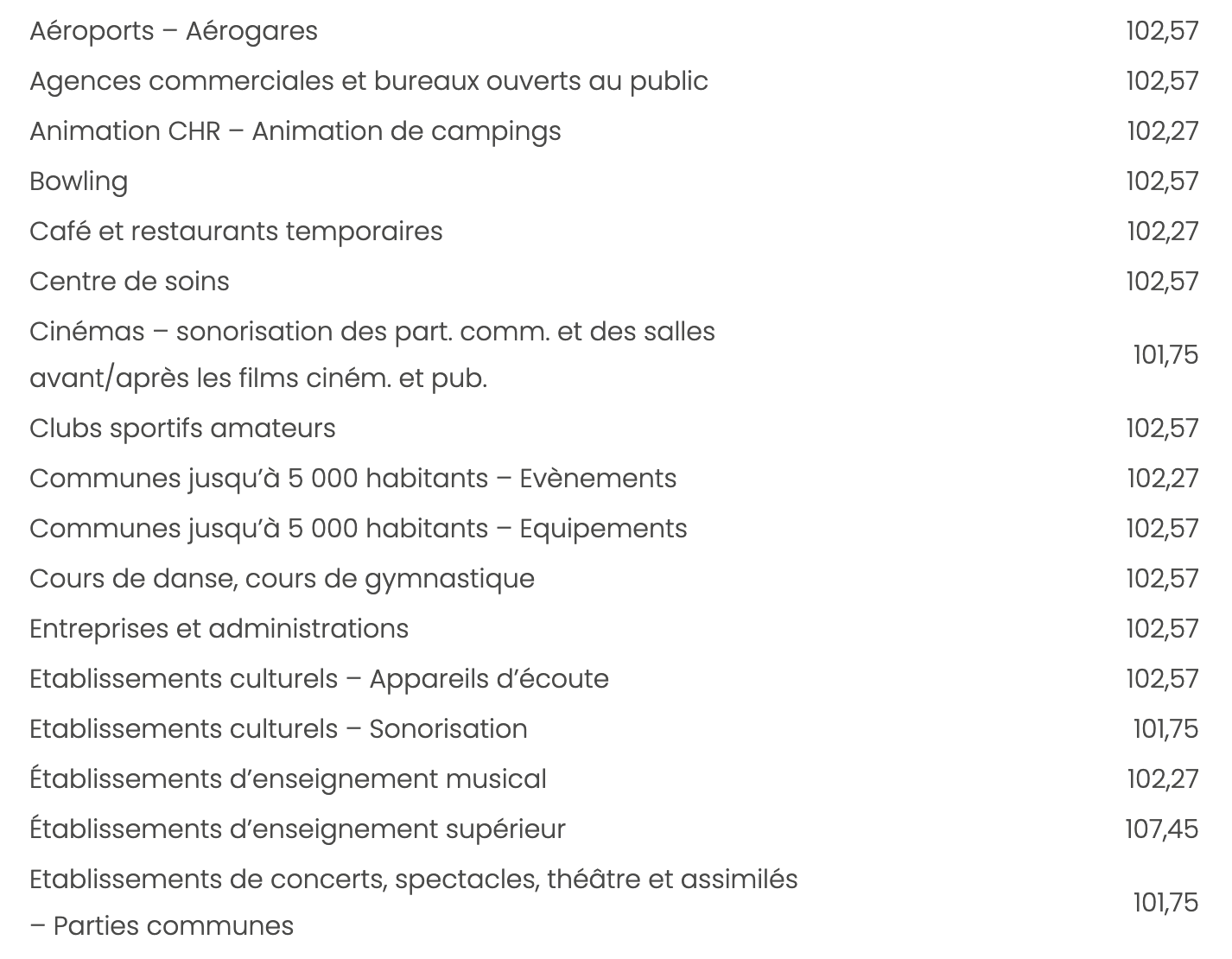
The amount corresponds to 65% of the Sacem tariff, with a minimum amount of €102.57 (excl. VAT) per establishment.
In practice, for a coworking facility: €102.57 ex.
6. Welche Musikdienste sind in Coworking Spaces legal?
6.1 Irrglaube
When it comes to legality and music, many beliefs are widespread, but unfortunately false, in sectors such as hospitality, retail, … Here are the most common, and those you need to know as a manager and responsible for a company or administration:
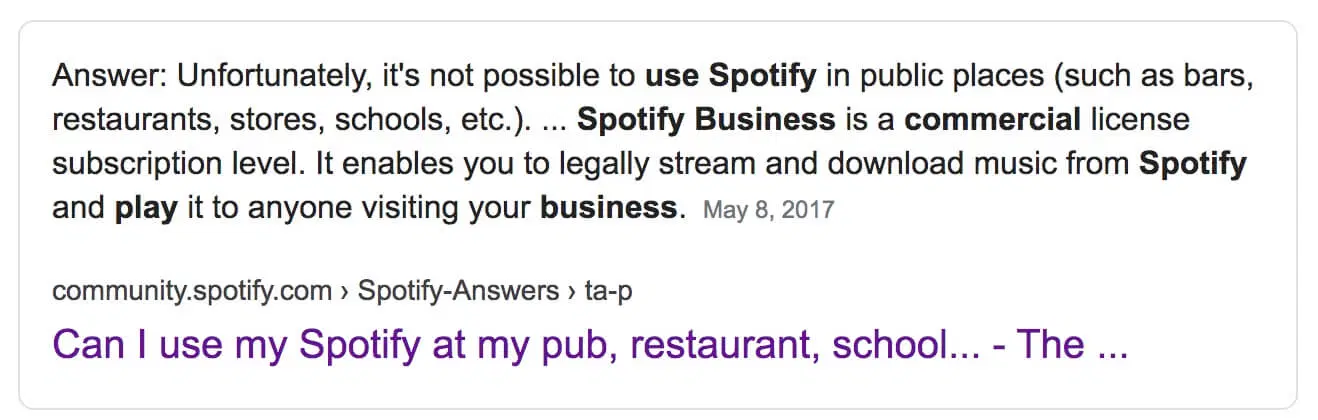
The most common misconception: Spotify, Youtube, Deezer, Apple Music, …
“If I have a paying (so-called “premium”) account with Deezer, Spotify, or other mainstream streaming services, and I pay an SACEM royalty, then I can legally play music in my coworking space. ”
FALSE!
What the law says:
Music streaming services such as Spotify, YouTube, Deezer or Apple Music are only licensed by SACEM for personal use. Their use in a public/commercial place such as a coworking space is illegal.
The following article explains everything you need to know – and unfortunately probably don’t know – about so-called mainstream streaming platforms and their illegal use in public spaces: learn more .
6.2. Welche Musikdienste sind in Coworking Spaces legal?
France’s leading provider of music streaming solutions for professionals, and coworking spaces in particular, is Soundsuit, which is based in Paris and Munich, and operates worldwide from Europe.
The Soundsuit solution has been ranked #1 music service in the comparison analysis.
Soundsuit is licensed as a music service for commercial use in public places such as stores, restaurants, cafés, bars, hotels, gyms, spas, medical practices, offices and coworking spaces. Soundsuit is licensed in over 50 countries worldwide, including France, the USA, Canada, the UK and all of Europe.
Get started and plan a tailor-made musical atmosphere for your co-working in just a few clicks. Try Soundsuit for free.

7. Schlussfolgerung
The fundamental difference lies in the growth criterion of the SACEM tariff.
Whereas in the case of a company or administration, the SACEM rate increases proportionally with the number of employees, in the case of a coworking space, the rate increases with the number of workstations.
This difference is fundamental, and means that Coworking Spaces often benefit from much lower rates than their traditional “Business and Administration” counterparts.
4. Können Sie in Ihrem Co-Working Space Musik senden, ohne die SACEM zu bezahlen?
All the songs you know (from radio, commercials or films) are subject to SACEM. There is, however, one exception: royalty-free music (often referred to unkindly as “elevator music”). These are works whose authors are not SACEM members and who have waived their copyright. A number of companies have stepped into this breach, offering royalty-free background music solutions (saving you the SACEM fee), suitable for use as background music in a coworking space. The financial advantage may seem obvious, but it’s not. Because the suppliers of this royalty-free music, under the pretext of saving you the SACEM royalty, sell the subscription to their service at a higher price.
In the end, the price of a subscription to a royalty-free music service is equivalent to, or often much more expensive than, that of a music service broadcasting well-known titles. The advantage lies elsewhere: you save yourself the red tape of applying to SACEM for authorization and paying your royalties.
On the other hand, the disadvantages of royalty-free music are numerous, and often unsuspected by coworking space managers:
a) This royalty-free music consists solely of tracks that are completely unknown to your customers/users, and often tasteless. So don’t expect to hear Souchon or Rihanna, let alone Nouvelle Vague or Daft Punk. Instead, you’ll hear instrumental tracks of rather rudimentary composition (a sort of “low-cost” lounge), with tracks that all sound like clones.
https://www.premiumbeat.com/fr/royalty-free-tracks/smell-the-coffee
b) As a result, your customers/users won’t be able to associate positive memories with certain songs they recognize (such as “Killing me softly” by The Fugees), and this emotional link with your establishment won’t be created.
In other words, copyright-free music can’t create emotions and therefore a bond with your customers. And it’s exactly these emotions and bonds that you’re looking to create through music to build customer loyalty with your coworking space.
5. SACEM 2025-Tarife für Coworking Spaces
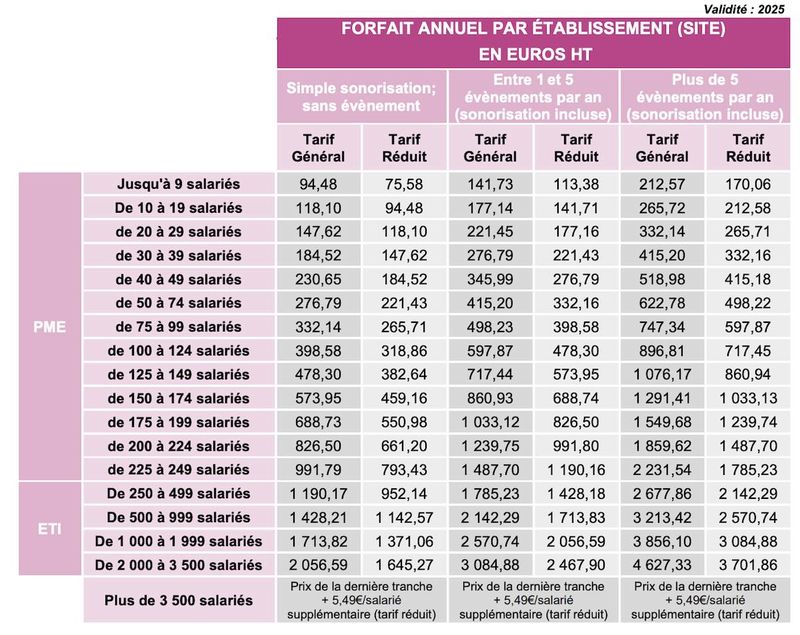
Die Höhe der Lizenzgebühren basiert auf einem jährlichen Pauschalbetrag pro Betrieb. Ein Unternehmen mit mehreren Niederlassungen muss so viele Pakete abonnieren, wie es Niederlassungen hat, die Musiksendungen ausstrahlen.
The amount of royalties is based on an annual lump sum that depends on :
When musical broadcasts are given with the help of live musicians, DJs and/or performers, the expenditure budget must not exceed €3,000 incl. tax per event.
3. Welche Musiksendungen fallen nicht unter den SACEM-Tarif für Coworking Spaces?
The following musical broadcasts are excluded:
After a much-needed update of their legislation, SACEM rules and tariffs now also apply to so-called “Coworking Spaces” and “Operated Offices”, i.e. shared workspaces in which the operator provides everyone with the tools and materials they need to work (internet connection, workstations, meeting rooms, kitchenettes, etc.).
In this case, the “number of employees” criterion (as indicated in the pricing grid in paragraph 5, originally designed for “companies and public authorities”) is to be replaced by “number of workstations”.
This excludes coworking spaces integrated into a structure whose main activity is not coworking (e.g. a coworking café with a coworking space).
2. Wann sollten Sie die SACEM für Ihren Coworking Space bezahlen?
If you manage a co-working space, you must pay a royalty to SACEM if you broadcast well-known music (and not so-called royalty-free music, see paragraph 4.1 on this subject) when :
Soundsuit
Bereit, Ihre Unternehmensmusik zu verbessern?
Schließen Sie sich über 10.000 Unternehmen an, die Soundsuit nutzen, um die richtige Musik zu spielen, rechtlich konform zu bleiben und das Kundenerlebnis zu verbessern.
Jetzt kostenlos testen