Wireless Restaurant Sound System: A Modern Setup with Soundsuit and Audio Pro Business
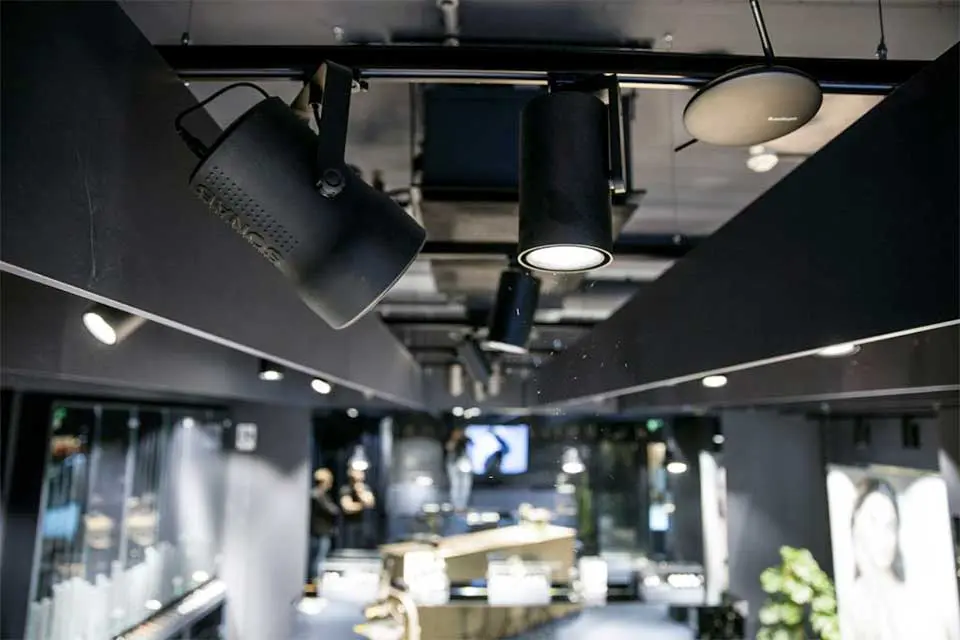
Designing a sound system for a restaurant, café, hotel or retail space has become significantly more complex over the last decade. Guests expect consistent sound quality, staff expect simple control, and operators need systems that are reliable, scalable, and easy to maintain across multiple locations.
At the same time, traditional audio installations — built around amplifiers, passive speakers, and long cable runs — are increasingly being replaced by more flexible and wireless architectures.
In this article, we break down how to build a modern wireless restaurant sound system using:
- Soundsuit as the music platform
- The Soundsuit Media Player as the dedicated audio source
- Audio Pro Business active wireless speakers as the output layer
This combination creates a clean, scalable, and installation-friendly system designed specifically for hospitality environments.
- 👉 Soundsuit Media Player: https://soundsuit.fm/streaming-and-media-player/
- 👉 Sonos for Business (alternative architecture): https://soundsuit.fm/sonos-for-business/
Why traditional restaurant sound systems are being replaced
For many years, restaurant audio systems were built around a simple principle:
One central amplifier → multiple passive speakers → fixed wiring across the venue.
While still functional, this approach introduces several challenges:
1. Complex installation
Speaker cables must be routed through ceilings and walls, often requiring professional installation work and structural constraints.
2. Limited flexibility
Once installed, changing speaker positions or expanding zones is costly and disruptive.
3. Central point of failure
If the amplifier fails, the entire venue loses audio.
4. High dependency on fixed infrastructure
Any change in layout or acoustics typically requires rewiring.
As a result, many modern hospitality operators are moving toward distributed active speaker systems.
What is a modern wireless restaurant sound system?
A modern system typically follows a different architecture:
- Audio source is separated from amplification
- Speakers are active (self-amplified)
- Audio is distributed wirelessly or over IP
- Control is centralized via software
This eliminates the need for a traditional amplifier entirely. The result is:
- faster installation
- fewer failure points
- easier scaling across multiple venues
- more flexible interior design
Active speakers: the foundation of modern audio installations
At the core of modern restaurant audio systems are active speakers.
Unlike passive speakers, active speakers include:
- integrated amplifier
- digital signal processing (DSP)
- wireless or network receiver (depending on system)
This means no external amplifier is required. Each speaker only needs:
- power (plug socket)
- audio signal (wireless or network-based)
This is a major simplification for hospitality environments.
Why Audio Pro Business is interesting for restaurants
One of the most compelling systems in this category is Audio Pro Business, a professional wireless speaker ecosystem designed specifically for commercial environments.
Unlike many consumer wireless speaker systems, Audio Pro Business does not rely on Wi-Fi. Instead, it uses a dedicated DECT-based wireless audio protocol (1.9 GHz).
This architectural choice has important implications in real-world restaurant environments.
DECT-based audio vs Wi-Fi-based audio
In busy venues, Wi-Fi networks are often shared between:
- guests
- staff POS systems
- tablets
- IoT devices
This can lead to congestion and unpredictable performance. Audio Pro Business avoids this entirely by using a dedicated wireless audio channel.
Key benefits:
- independent from guest Wi-Fi traffic
- stable synchronization between speakers
- low latency audio transmission
- consistent performance across peak hours
- long-range indoor coverage
For restaurants, cafés, and hotels, this translates into one key outcome: predictable, infrastructure-independent audio playback.
How Soundsuit fits into the system
While Audio Pro Business handles the physical audio distribution, Soundsuit provides the music layer.
The recommended architecture uses the Soundsuit Media Player as the dedicated streaming source. This device is designed for commercial use and runs continuously in the background.
System architecture overview
A typical installation follows the architecture shown in the hero diagram at the top of this article: the Soundsuit Platform feeds the Media Player, which sends an analog line signal into the Audio Pro TX-1. The TX-1 then distributes that signal over DECT wireless to every paired speaker in the zone.
The Media Player continuously streams licensed Soundsuit music, while the TX-1 distributes the signal wirelessly to all paired speakers.
One restaurant = one sound zone
In most restaurant environments, a single acoustic zone is sufficient. A standard setup includes:
- 1 × Soundsuit Media Player
- 1 × Audio Pro Business TX-1 transmitter
- 4 × Audio Pro Business active speakers
This setup is ideal for:
- restaurants (single room)
- cafés
- wine bars
- boutique retail spaces
- hotel breakfast areas
The result is:
- perfectly synchronized audio
- no amplifier required
- no speaker cabling
- simple plug-and-play deployment
Scaling to multiple restaurants
For restaurant groups or hospitality chains, this architecture scales very cleanly. Each location simply includes:
- one Soundsuit Media Player
- one Audio Pro Business transmitter
- a set of active wireless speakers
Centralized management is handled entirely through Soundsuit:
- playlists
- scheduling
- branding
- multi-location control
- seasonal programming
This allows operators to maintain a consistent sound identity across all venues while keeping physical installations simple and independent.
Audio Pro Business vs Sonos for restaurants
Both Audio Pro Business and Sonos are widely used in commercial environments, but they follow different design philosophies.
| Feature | Audio Pro Business | Sonos for Business |
|---|---|---|
| Wireless technology | DECT (dedicated) | Wi-Fi |
| Dependency on guest network | No | Yes |
| Installation complexity | Low | Low |
| Ecosystem maturity | Professional AV-focused | Consumer + business hybrid |
| Best use case | Dedicated commercial installs | Flexible mixed environments |
| Integration with Soundsuit | Line-in via TX-1 | Line-in / network integration |
👉 Sonos alternative architecture: https://soundsuit.fm/sonos-for-business/
Neither system is universally "better" — they simply optimize for different priorities.
Why the Soundsuit Media Player matters
While Soundsuit can run on phones, tablets, or computers, many hospitality operators prefer a dedicated hardware device. The Media Player provides:
- plug-and-play installation
- no employee login required
- automatic restart after power loss
- stable 24/7 playback
- tamper-resistant operation
- centralized remote control
This makes it significantly more reliable than consumer devices in operational environments.
Typical deployment example
A real-world restaurant installation might look like this:
- 1 × Soundsuit Media Player hidden in technical room
- 1 × Audio Pro TX-1 connected via line-out
- 4 × wall-mounted or ceiling-positioned active speakers
- single power source per speaker
No amplifier rack. No speaker cabling. No dependency on guest Wi-Fi.
When this system is the right choice
This architecture is particularly well suited for:
- restaurants and cafés
- boutique hotels
- retail stores
- wellness and fitness studios
- multi-location hospitality brands
- venues with unreliable Wi-Fi infrastructure
It is less suited for:
- large multi-zone clubs requiring complex routing
- venues with extensive live audio production needs
Conclusion
Modern restaurant audio systems are shifting away from centralized amplifier-based installations toward distributed, wireless, active speaker architectures. By combining:
- Soundsuit (music platform + licensing)
- Soundsuit Media Player (dedicated audio source)
- Audio Pro Business (DECT wireless speaker system)
you can build a system that is:
- fully wireless (no speaker cabling)
- amplifier-free
- highly reliable in real-world restaurant conditions
- easy to install and scale
- centrally managed across multiple locations
Whether used in a single café or a global restaurant chain, this architecture offers a pragmatic and future-proof approach to commercial background music.
Soundsuit
Ready to elevate your business music?
Join 10,000+ businesses that use Soundsuit to play the right music, stay legally compliant, and boost customer experience.
Start your free trial