Best Sound Systems for Retail Stores in 2026
Create a shopping atmosphere that sounds as good as it looks
When you open a new store—or give an existing location a makeover—music matters as much as lighting, signage, and merchandising. The first step: choose the right sound system. This guide walks you through the three decisions that shape great in-store audio:
- Hardware
- How many speakers?
- Wired, wireless, or a hybrid setup?
- External streamer or all-in-one?
- Music Source
- Local playlists or a licensed streaming service?
- Copyright Compliance
- Which licenses are required (or already included)?
Our goal is to help you find a system that is:
- Easy to install and expand
- Simple for staff to operate
- Modern and streaming-ready
- Cost-effective for small and mid-sized spaces (400–6,000 sq ft) — with options that scale beyond 10,000 sq ft
1.1 Re-using an Existing Wired System
Option A – Plug your own device into the amplifier
Stream from a phone, tablet, or laptop and connect with an RCA cable.
Pros
- Keeps ceiling or wall speakers in service
- Full control from a familiar screen
Cons
- Device is tied up (POS or inventory apps compete for resources)
- Easy to close the streaming tab by accident
- Continuous streaming can overheat consumer devices
Option B – Add a dedicated streaming player
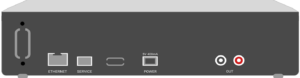
Many business-grade music services offer a compact, pre-configured player that plugs into your amp via Ethernet.
Why retailers choose it
- Plug-and-play: Arrives preset—music starts instantly
- Stable: Hard-wired, with an SD-card fail-safe for outages
- Tamper-proof: No buttons for staff to change settings
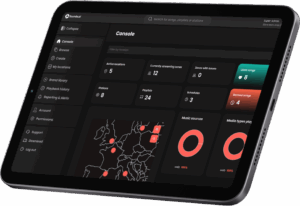
Typical chain rollout: Streaming player → Ethernet → Router → Amplifier → Existing speakers. Corporate teams manage every store from a cloud dashboard.
Example: the Soundsuit Media & Streaming Player.
The music is controlled via the Soundsuit Admin-Dashboard.
1.2 Buying a New Wired System
Here are proven “starter packs” for single-zone floor plans. Prices are ballpark (USD).
| Size | Coverage | Package | What’s Included | Approx. Cost |
|---|---|---|---|---|
| S | up to 540 sq ft | JBL + T.Amp
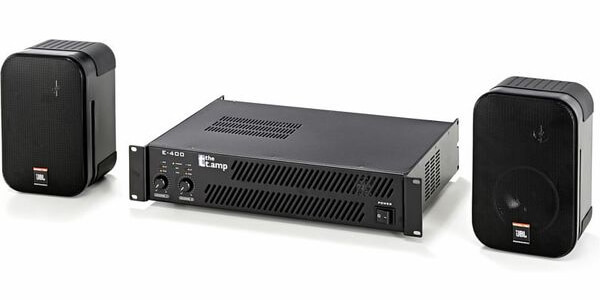 |
2 × JBL Control 1Pro + T-Amp E-1500 | $499 |
| M | up to 800 sq ft | Bose FreeSpace
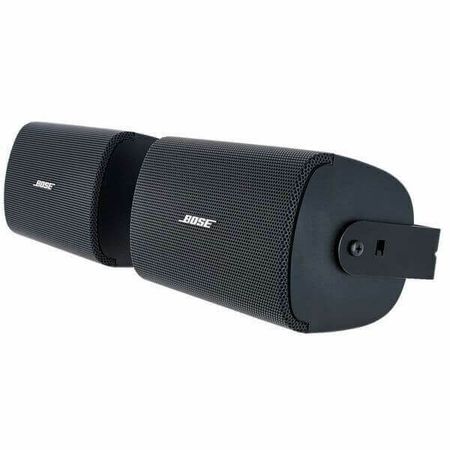 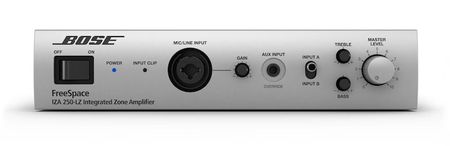 |
4 × FS2SE + IZA 250-LZ amp | $1,099 |
| M (design) | up to 800 sq ft | Bose DesignMax
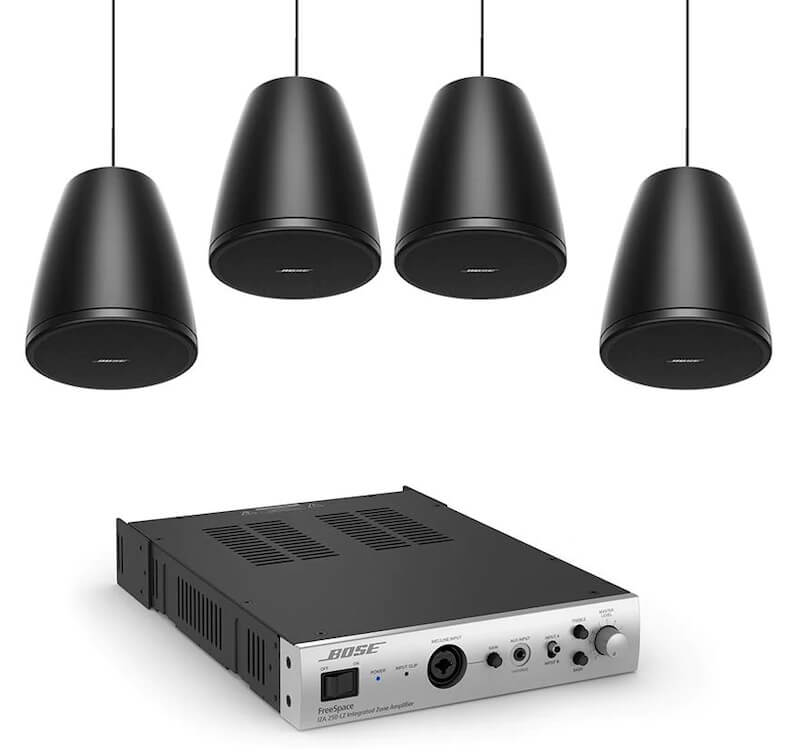 |
4 × DM3P + same amp | $1,299 |
| L | up to 3,200 sq ft | Bose DesignMax + PowerSpace
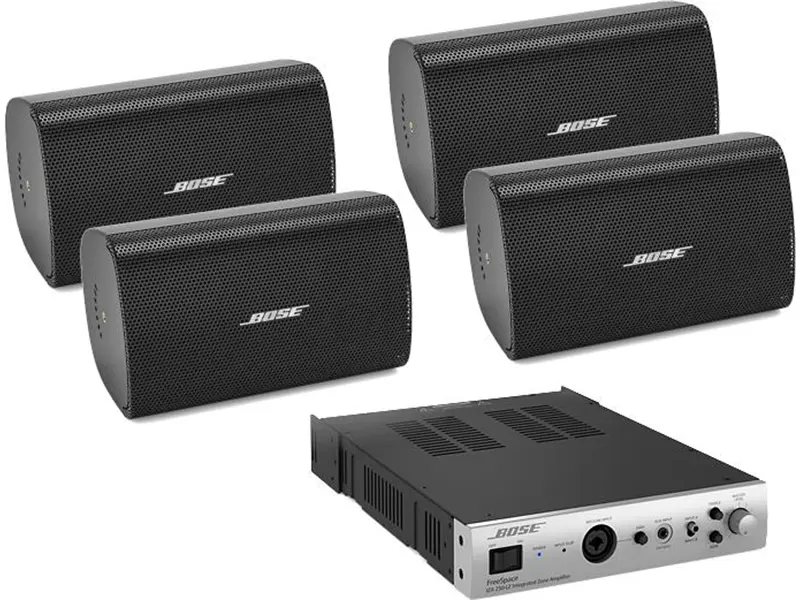 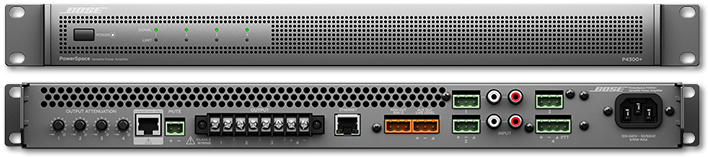 |
8 × DM3SE + P4300+ amp | $5,099 |
| XL–XXXL | 3,200 sq ft + | Custom
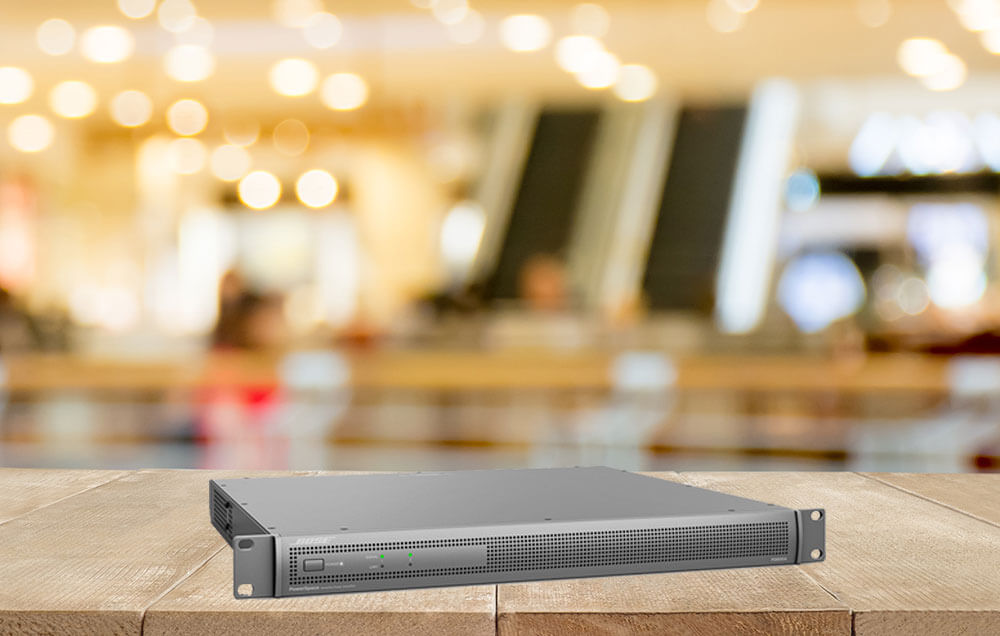 |
Multi-zone matrix, amps, speakers | Quote |
For flagship stores or multi-level footprints, hire an audio integrator to design a custom multi-zone system.

1.3 Sonos wireless speakers (Era-100 Pro hardware line)
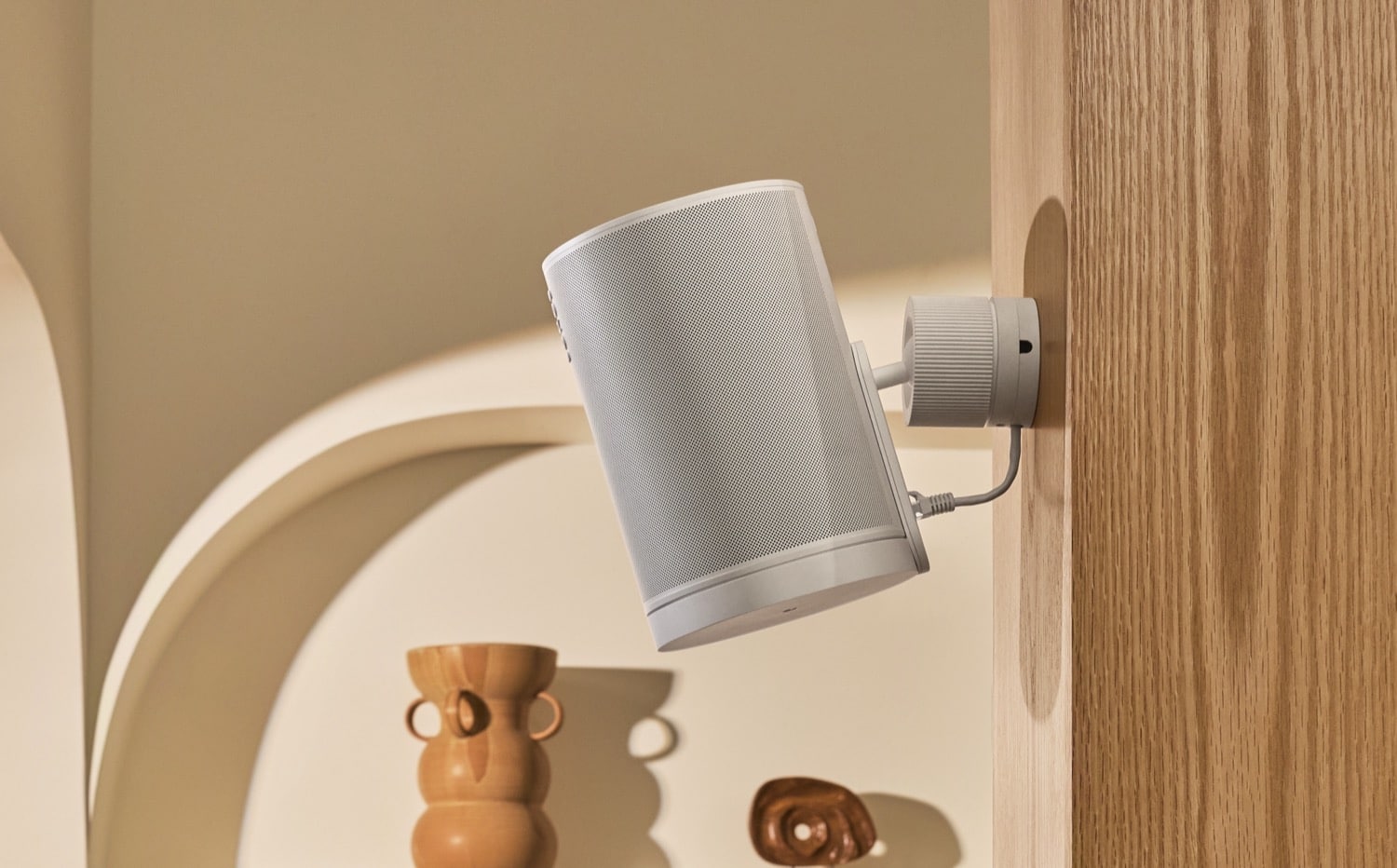
For boutiques and mid-sized stores, Sonos remains a fast, “plug-and-play” speaker ecosystem. The latest Era-100 Pro is an installer-grade model with PoE power/networking and a secure wall-mount bracket with cable management—ideal for retail. (This section covers the hardware line only.)
What’s useful for retailers
| Feature | Benefit for Retailers |
| Power-over-Ethernet options | Single Cat-6 can power and carry audio—less Wi-Fi load and better uptime. |
| Secure mounts | Lockable brackets and tidy cable management keep speakers tamper-resistant and well-aimed. |
| Tuning & presets | Out-of-box EQ curves speed setup for common retail areas. |
| Central oversight | Fleet-level volume caps, zone grouping, and device health (via compatible admin tools). |
Sizing guide: In many floor plans you’ll need roughly two compact speakers per ~430 sq ft (40 m²). For deeper bass, add a subwoofer.
Why integrators like it
- Hybrid options: Mix Ethernet-enabled and Wi-Fi speakers to match network capacity and budget.
- Faster installs: A single run of Ethernet per location can reduce labor vs. separate power + audio.
- Corporate control: Multi-site chains can cap volumes, push updates, and schedule content centrally.
Era-100 Pro mounted in retail
1.4 Chromecast Audio (Google Cast)
Chromecast-enabled speakers (or a WiiM Pro streamer, typically ~$149–$179) let you cast directly from a phone over Wi-Fi.
Pros
- Works with many brands (JBL, Onkyo, Sony, B&O)
- Multiple managers can control playback
Cons
- Relies on busy Wi-Fi channels
- Not legal for business if you cast consumer services like Spotify/Apple Music
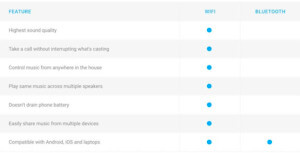
See how Google Cast compares to Bluetooth >
1.4 Limits of Wi-Fi-dependent systems
One common complaint from wireless users is Wi-Fi robustness. In stores, Wi-Fi can be crowded and prone to interference (POS, TVs, guest access, staff phones, tablets, VoIP, PCs). Advanced fixes (e.g., DHCP reservations, channel planning) help but often require IT support. A simpler path is to avoid Wi-Fi for audio streaming.
Useful community thread on network stability
1.5 Ethernet-Only Streaming: Bluesound Professional
If in-store Wi-Fi is congested with POS and guest access, Bluesound Pro’s PoE speakers and rack players deliver rock-solid, high-res audio with zero Wi-Fi dependency.
Network Streaming Player B100S
- Adds Ethernet streaming to any amp
- Pricing:
-
USA: typically $749 USD at pro dealers; some list $685 USD. Expect ~$685–$749 USD before tax. Full Compass Systems+2Creation Networks+2
-
EU: commonly €649 EUR incl. VAT; some distributors show list/RRP around €871 EUR. UK promos have dipped to ~£463 inc VAT. So plan ~€649 (typical) to €870 (RRP). MUSIC1ST+2Bekafun+2
Notes: EU prices usually include VAT; US prices are pre-tax. Availability and promos swing pricing, so confirm with your preferred reseller.
-
Speaker BSP 200
- PoE-powered
- IP65 outdoor-rated
- App-controlledStreet pricing
-
USA: $436–$471 USD each (before sales tax), depending on dealer and stock. Examples: Creation Networks and Full Compass list $436, while Crutchfield shows $471. Crutchfield+3Creation Networks+3Full Compass Systems+3
-
EU: Typically €485 EUR each incl. VAT at major shops; occasional promos as low as €349 EUR. Auditorium+2Auditorium+2
Notes: EUR prices usually include VAT; US prices are before local tax. Stock status can swing the price a bit.
-
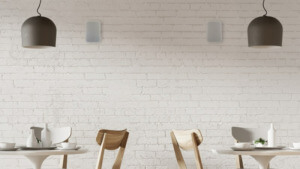

Network Streaming Speaker BSP 500
The Bluesound Professional BSP500 is a network active loudspeaker with integrated streaming capability designed specifically for use in either indoor or outdoor commercial installations. This unit is powered by Power over Ethernet(PoE) allowing a one-wire connection to the speaker for both power and audio. The player in the BSP500 is based on the established BluOS platform and is capable of playing and distributing content from local network storage as well as from a large number of streaming services, including some specifically designed for commercial use.
Street pricing:
-
USA: ~$749 USD at several pro dealers (e.g., Full Compass, Creation Networks). Some retailers list a bit higher (e.g., $809 at Crutchfield). So expect $749–$809 USD per speaker (tax extra).
-
EU: Commonly €699–€772 EUR incl. VAT, with promos as low as €619 EUR in some shops. (Examples: €699 at Music1st; €772 at Auditorium/Grobi; €619 promo at Vision; €719–€699 at other EU sellers.)
Notes:
-
EUR prices generally include VAT; US prices typically exclude sales tax.
-
Black/White variants usually price the same.
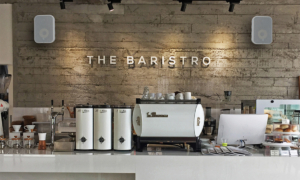
The Bluesound Professional line, in a nutshell:
- Glitch-free streaming over wired Ethernet
- Control from Windows/Mac and iOS/Android
- Security to prevent unauthorized changes
- Wall-mount bracket with wide swivel/rotation
- IP65 rating for indoor/outdoor use
- Supports up to 192kHz/24-bit and MQA files
- No front-panel controls (prevents tampering)
Pair of BSP200 speakers in a café
1.6 Wi-Fi-Free & Wireless: Audio Pro Business
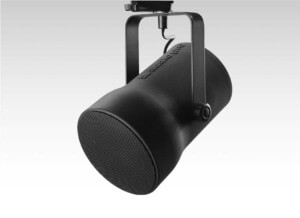
Audio Pro uses DECT (long-range cordless-phone standard) instead of Wi-Fi.
- Up to 6 independent volume zones
- Twice the range of typical Wi-Fi systems
- Mounts directly to track lighting—reposition speakers as layouts change
- ~30% more than a Sonos system; professional install recommended
Use-case 1 | Store size “S”
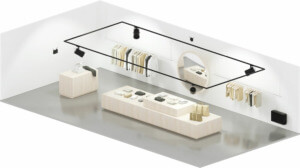
Surface: 40–100 m² • Install: ~1 hour • Material: 4 speakers, 1 sub, 1 transmitter, 1 volume control
Use-case 2 | Store size “M”
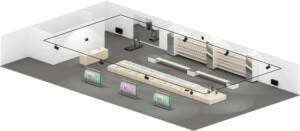
Surface: 100–200 m² • Install: 2–3 hours • Material: 8 speakers, 2 subs, 1 transmitter, 1 volume control • Advantage: multiple volume zones
Use-case 3 | Store size “L”
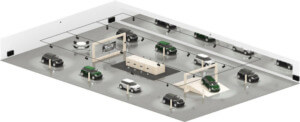
Surface: 200–400 m² • Install: custom • Material: 16 speakers, 3 subs, 2 transmitters, 2 volume controls • Advantage: multi-room with distinct ambiences
Use-case 4 | Store size “XXL”
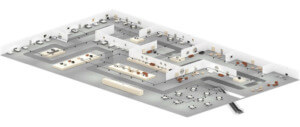
Surface: 800 m²+ • Install: custom • Material: ~80 speakers, 4 subs, 4 transmitters, 4 volume controls
In-wall mounted wireless speakers
Track-mounted speakers let you move, add, or re-angle units as layouts evolve—fast and agile. If you don’t use lighting tracks, Audio Pro also offers wall-mounted wireless speakers that only need a nearby outlet.
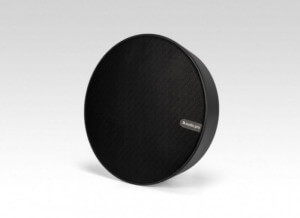
Pricing: expect about ~30% more than an equivalent Sonos system, plus optional installer time. Find Audio Pro Business resellers.
Quick comparison: wired, PoE, Wi-Fi and DECT options
| Solution | Install speed | Reliability / Network load | Multi-zone & remote control | Scale | Typical cost* / zone | Best for |
|---|---|---|---|---|---|---|
| Wired (amp + passive speakers)
70V/100V or 4–8Ω
|
Medium | Rock-solid / Low | Via matrix amps/players; great dashboards | Large+ | $400–$1,200+ | Any store needing long runs & many speakers |
| Sonos (Era-100 Pro etc.)
Pro hardware adds PoE & secure mounts
|
Fast | High (PoE) / Moderate (Wi-Fi) | Strong (good ecosystem control) | Small–Mid chains | $300–$800+ | Boutiques & chains wanting quick rollouts |
| Chromecast / Google Cast
e.g., WiiM Pro
|
Fast | Wi-Fi dependent | Basic multi-room; limited admin | Small | $150–$300 | Temporary setups; not for compliance streaming |
| Bluesound Professional (PoE) | Medium | Wired/PoE – Low load | Strong (pro app & APIs) | Mid–Large | $350–$800+ | Busy networks; high uptime requirements |
| Audio Pro Business (DECT) | Fast | Bypasses Wi-Fi | Up to 6 volume zones; add-move-change friendly | Small–Mid | $500–$900+ | Flexible layouts; retail remodels, pop-ups |
Choosing 70V/100V vs 4–8Ω
- 70V/100V: long cable runs, many speakers per zone, easier expansion; slightly less hi-fi.
- 4–8Ω: fewer speakers, higher fidelity; keep runs short; match amp/speaker loads carefully.
- Rule of thumb: large floors or ceilings ≥12 ft → start with 70V/100V.
Coverage & Loudness
- Spacing: ~1 speaker / 200–300 sq ft at ~10-ft ceilings (tighten as ceilings rise).
- Target dBA: retail 70–75, cafés 72–78, gyms 80–85.
- Headroom: spec amps with ~20–30% extra power over calculated load.
2. Selecting a Music Source
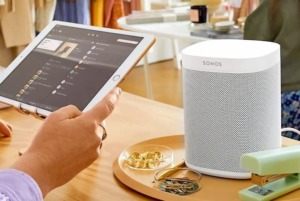
- Skip CDs and FM radio — they’re labor-intensive and filled with ads.
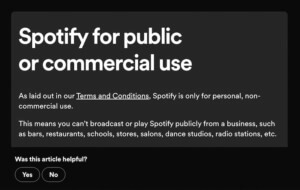
- Consumer streaming (Spotify, Apple Music, etc.) is not licensed for commercial use, even with a paid account.
Choose a licensed business music service that offers:
- Curated playlists tailored to your brand demographic
- Smart day-part scheduling (morning chill, afternoon mellow, evening upbeat)
- A mobile or web dashboard for real-time mood tweaks
- U.S./Canada: PRO fees (e.g., ASCAP, BMI, SOCAN) typically included by the provider — confirm in writing
- Elsewhere: pay your local collection society (PRS, GEMA, SACEM, etc.) in addition to the service
Popular providers
| Type | Services | Typical Price |
| Royalty-free | Jamendo, Epidemic Sound, Music2Biz | $10–$40 /mo /zone |
| Licensed (full catalog) | Soundsuit, MyInstoreRadio, Mood Media | ≈ $29–$49 /mo /zone |
In a business, you cannot use Spotify, Apple Music, Amazon Music, Qobuz, Tidal, YouTube Music, Pandora, or similar consumer services for public playback. Learn more in The Practical Guide to Legally Play Music in Your Business.
If you use a smart TV to show video clips (e.g., YouTube), note that most B2C video platforms are not licensed for commercial display in public areas.
Professional music services streamline daily operations
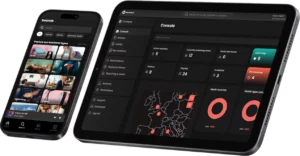
You gain peace of mind: playlists are refreshed regularly and tailored to your brand and audience. See how Soundsuit works and compare pricing.
3. Staying Legal
- U.S. & Canada: Many business music services include PRO royalties (e.g., ASCAP, BMI, SOCAN) for background music. Coverage varies—confirm in writing which societies and use-cases are included.
- EU & Rest of World: You typically still pay your local society (PRS, GEMA, SACEM, etc.) even when using a licensed service.
Key exceptions (U.S. & Canada)
Contact local PROs to secure additional licenses if you:
- Conduct fitness/dance classes set to music
- Use DJs, karaoke, or live music beyond background playback
- Charge admission/cover related to music
In the EU/ROW, background music normally requires a license from your collecting society regardless of your streaming provider.
Conclusion
Choosing the perfect store sound system is straightforward when you match:
- Floor size & layout (single area vs. multi-zone)
- Existing infrastructure (reuse wired speakers or start fresh)
- Control needs (simple app vs. advanced DSP)
- Scalability (future expansions or remodels)
- Budget (hardware, installation, music service, licensing)
Investing upfront pays back every day: a well-designed soundtrack keeps shoppers comfortable, increases dwell time, lifts basket size, and strengthens brand identity.
Sound good? Then you’re ready to start planning your future sound system.
Soundsuit
Ready to elevate your business music?
Join 10,000+ businesses that use Soundsuit to play the right music, stay legally compliant, and boost customer experience.
Start your free trial