6 Essential Music Licensing Tips for Restaurants in 2026

88% of businesses worldwide play music for entertaining and even better motivating and engaging their customers. This is massive.
In the restaurant industry this number rockets even higher, especially in bigger cities. But playing music is not as simple as putting a record on a turntable like in the 70’s.
The complex legislation, the new available technologies, the million of possible music tracks to playlist… All this sounds overwhelming for most restaurant owners.
But music stays an essential success factor for modern businesses of the restaurant & catering industry.
We will give you here the 6 essential music licensing tips for restaurants, bars, bistros, or pubs to succeed in 2021. The goal is to be able to run your business with peace of mind when it comes to:
-
- the license you need to play music in your restaurants, bars or cafes
- the way the license fees are calculated
- the “elevator music” to avoid
- the music that motivates and engage customers
- the importance of using a licensed B2B music provider to comply with the law
- how to avoid all the manual work when it comes to playlisting music, and save time
Copyright fees, music licenses, tariffs, hidden costs, legal providers vs illegal ones, music that sells, etc. This article aims at answering all these questions and helping you solve the music topic in your business to be able to focus on the multiple other tasks you need to take care about.
Running a business is hard enough, playing great engaging music shouldn’t.
Tip#1 – You need a license for background music. Mandatory.
The music licensing tip number one is dead simple: if you play licensed music in your restaurant, bar, coffee shop., bistro or pub, you need to get a license to comply with the law!
Anyone who plays copyrighted music in public and commercial place like a café is obliged to pay a fee to the Copyright Collecting Society of his country of residence.
What is licensed music exactly?
We speak here about “licensed or copyrighted music” when it deals with known, recognised, established music with artists signed by labels. Rihanna, Stevie Wonder, Daft Punk, the Beatles, etc.
In one word, the artists that your customers love and expect you to play. We do not speak here about “elevator music”, obscure, non copyrighted, known by no one, cheap music tracks, remembering the music often played in elevators in the 70s and 80s.
But we will highlight the difference between these two categories of music later in this article.
What are these “Copyright Collecting Societies”?
When we speak about “Copyright Collecting Societies”, we speak about PRS-PPL (UK), GEMA (Germany), SUISA (Switzerland), SACEM (France), etc.
Societies you know for sure about as a business owner! These societies form the interface between music users (you as a private person listening to music, but also your business broadcasting music to your customers) and the music right holders (e.g. singers, bands, songwriters, publishers).
Their role is to protect the copyrights of the artists, and thus give them a source of financial revenue when their music work is used/played (e.g. in a restaurant to an audience of customers).
Copyrighted music
It doesn’t matter whether you play party-like music in a bar or soft background music in a restaurant. As soon as music is playing, your business and location must be registered. The music licensing legislation is fairly simple but also strict.
We are of course talking about well-known, recognized and established music with artists who have been signed by labels. Rihanna, Stevie Wonder, Daft Punk, The Beatles.
Tip#2 – How is your licensing fee calculated?
Whatever the country where you run your catering/restaurant business, your local “Copyright Collecting Society” will have an Internet website where you can read about the music licensing for restaurants, and also get the tariff related to your exact business, e.g. restaurant, bar, bistro, pub, etc. Because difference may exist in the applied tariff according to your very precise business type.
For a given location, varying from country to country, this tariff could then depend on:
-
- The type of business you broadcast music in (e.g. a cafe, a pub, a restaurant, an event catering, etc.)
-
- The surface of the zone/area that you broadcast music in
-
- The number of employees you have to run your location
-
- The music source/provider you use to get your background music from
Note that in the UK, the PRS-PPL is not directly publishing their tariffs. As we explain in this article “Licensed background music for business – can i use Spotify, Deezer, Apple & others?, you will have to send a request to PRS-PPL, via their website, to get the precise, up-to-date, tariff that applies to your business.
Tip#3 – Avoid to use “elevator music” and to scare away your customers
Avoiding music licensing fees is tempting
If you play only non copyrighted tracks, by artists not signed by any labels, the above mentioned fees will not apply. It is on the paper kind of tempting! This kind of music is called copyright-free music.
You will google it and find tons of service providers offering such music at a fair price. Knowing that we will not need to pay the related fees to PRS-PPL, GEMA, SACEM, KONA, etc., the deal sounds then interesting.
Quality difference between copyrighted and copyright-free titles
But… because there is a trap here! Imagine which artists will not wish to get money back – through copyrights – for their work? Would it be a great music work, produced with talented artists?
A potentially great song will get copyrighted and his authors will wish for a large audience to listen to it and the song to be played and played again during the next 40 years to get the proportional royalties back for it. It is called a music hit.
Example of copyright-free music.
Examples of high quality copyrighted music by artists your customers love.
Avoid elevator music! Use quality music, and positively impact your customers.
What we nicely try to say here is that non-licensed music, giving no royalty to their authors, is not quality music. It is music without ambition. It is music without soul. It is not songs you hear on the radio, in movies, or dance to in clubs. It is music that is designed to be sold cheaply to service aggregators and broadcast as “elevator music”.
Expect obscure, unknown, cheap music tracks, like the ones often played in elevators in the 70s and 80s. These re not the tracks that your customers will enjoy and get motivate and engage with. Your customers will not expect to her such cheap music in any modern restaurant, pub, bistro, cafe or event.
Tip#4 – Only great known songs motivate customers in restaurants
Worse, “the so called elevator music”, i.e. non-licensed/copyrighted music, does not do the job! This kind of music does not engage and entertain customers as music from the charts does.
Referring to a study by SACEM in 2016, 65% of in-store customers want to hear music that they know or identify as high artistic quality.
They find unfamiliar or lower quality songs, such as copyright-free music, annoying and non-engaging. Do not imagine to create a superior music atmosphere for your business, truly inspiring and engaging your customers, if playing second league music!
This so called “elevator music” compiles only songs that none of your customers know nor love.
Providers of royalty-free background music and providers of copyrighted/licensed music do not differ significantly in price. Surprisingly! Here is a list of few providers:
Providers of copyright-free music
-
- Jamendo (Luxemburg) – from 5 to €20 / month per location
- Epidemicsound (Sweden) – prices on request only
- Music2biz (Germany) – from 10 to €40 / month per location
Providers of copyrighted background music
-
- MyInstoreRadio (USA) – €29 / month per location
- Ketchup Music (Germany) – prices on request only
- Soundsuit (Germany) – €29 / month per location
- Soundexperts (Germany) – from €45 / month per location (+ one-time payment of €249 for a receiver)
- Moodmedia (Canada) – from €80 / month per location (+ one-time payment of €399 for a receiver)
Look carefully at the price difference, and think about the value add of real cool music on your customers. Happiness, good mood, , longer stay in your restaurant, high probability to come back… what you get from great music is not what you get from elevator music.
The difference in cost is not worth it when you consider the “return on investment” you get regarding customer engagement, happiness and loyalty.
Tip#5 – Getting your license is only 50% of your duty. Pick also a licensed music provider.
The copyright fees are not everything you should consider. Registering your gastronomy with the PRS-PPL/GEMA/SACEM, etc. only entitles you to play music at all. In addition, you have to make sure that the titles you play are explicitly licensed for commercial use. And this is where it’s becoming tricky.
Private use versus commercial use
Imagine that you now own a license from the PRS-PPL, and that you buy tons of songs on iTunes. You of course pay the bill with your business account and business credit card, and start to play these MP3s randomly in your store. What do you get? A basic background music, not efficient on consumer behavior, but at least existing. Yes. And because you own a PRS-PPL license, and payed the MP3s with your business account, you are clean and can use this music legally in your store. Actually no! You are not clean, you are in fact committing a fraud. No kidding. How come?
You need to pay the licensing for these songs you bought. These songs you bought are licensed for private use only. At home, in your car, in your phone when you exercise, etc.
But not to be played in a public place like a business, i.e. for commercial use, to a large audience of customers. You need another specific license for this. For each of the song you play!
Mission impossible of course. You will not start calling around all the labels, all the artists and negotiate licensing rights to play their music work in your store. If yes, good luck.
Professional (B2B) music providers
This is why you use a professional music service provider, that will get you all the songs you need, and already licensed for commercial use in a business. These providers sell CDs, MP3s, or streaming subscriptions.
They are just B2B providers, and their “products” are licensed for commercial use. And you cannot get them at any music store online (Amazon, iTunes, etc.) or any music stores at the corner of your street (if these ones still exist, by the way :-)).
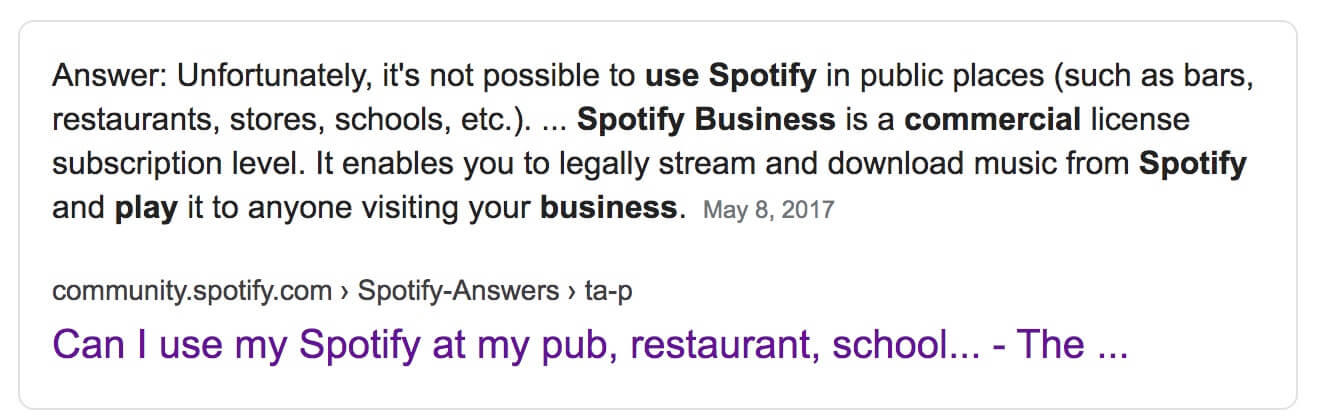
So yes, if you are reading this and getting the point: using mainstream music streaming services such as Deezer, Apple Music, Amazon Music, Napster, Pandora or Spotify in your store is also illegal.
Same logic again: these services are only licensed for private use, and not for commercial use. Here is a screenshot taken directly from the Spotify FAQ section online:
We also devoted a specific article to this topic here: Can is use Spotify, Deezer, Apple and others in my business?
For you, this means that if you stream music via one of these services or play other unlicensed music, you may face high additional payments and fines despite the registration of your restaurant, bistro, bar or cafe to your local Copyright Collecting Agency (e.g. PRS-PPL, GEMA, SACEM, etc.).
Tip#6 – Got the license. Picked a legal provider. But are you ready for all the manual playlist work?
Now that you got the license to play background music in your business, and that you picked a licensed B2B music provider to get the music from, you may think that you are finally done.
Well, let’s face the truth, there is still lots of work on a daily basis for you and your staff:
-
- updating your playlists daily or at least weekly.
- preparing playlist for the morning, with a quieter mood and tempo… except of course at opening time, where you would prefer to energize your staff and get everyone up and running.
- preparing playlists for afternoon, with few very carefully designed ones for the weekend afternoons and evenings
- and the ones for the happy hour. Essential!
- without forgetting the ones for the Christmas break, and the special events
- etc.
Do you plan to do all this yourself? Do you have a dedicated person in your team, with music skills and extra-time to do this? Great for you.
But most of the small to mid-size business owners we know struggle with this. Music is essential to the great atmosphere they want to offer to their guests and employees, but it is very time consuming, and not easy work with the skills and the scheduling software tools.
And more than everything, this is not core to their business. They have so many other important things to focus on and take care about.
Play it smart: what Tim Mälzer (i.e. the “German Jamie Oliver”) uses as a music service in his very successful restaurant.

“ We invested quite some time to find a modern streaming solution. For our premium restaurant, we wanted a trendy while decent music playlist. Today we are very happy to have opted for Soundsuit. ”
Tim Mälzer

Soundsuit relies on smart technologies to adjust, adapt and autopilot the music atmosphere in your store. You have no manual work any longer.
The right songs are played at the right time of the day, for your target customer group. It’s all automated. Running a business is hard enough, managing in-store music shouldn’t.
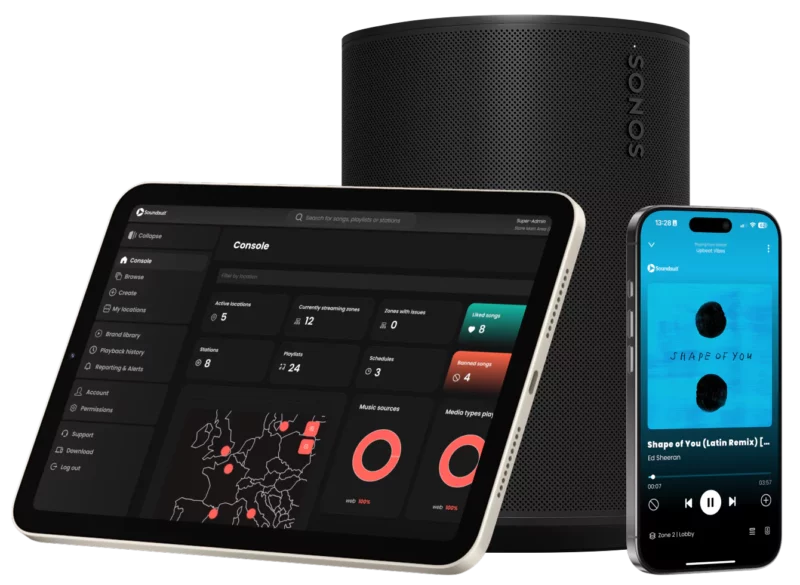
Each time you like or skip a song, and adjust the mood, Soundsuit learns more about your preferences and needs. Day after day, Soundsuit manages your music for your store. Autonomously. Of course you can jump it any moment and skip a song, and mood up or down the tempo. But Soundsuit makes sure that 90% of the time you are busy with your business tasks, the right songs are played at the right time of the day. All specifically tailored to your customers. We call it smart in-store music. Try it for free during 30 days. No credit card required, no commitment.
Conclusion
Background music for your business is a strategic choice: great music that your customers love and will get engage and motivated with. Or royalty-free music, the so called “elevator music”, that will annoy your customers and may make them never come back.
If you decide to go fro a music ambience that drives a superior customer experience, do your homework:
-
- get the license that allow your business to simply play licensed music. You then fulfil 50% the law.
- get a B2B music service provider that is also licensed for commercial use in businesses. You now fulfil 100% the law.
- evaluate the time and effort that you want to spend building yourself your playlists and scheduling them correctly throughout the week, weekends, and seasons. And maybe reconsider the choice you made about your music provider. Smart in-store music is what modern business owners could wish for. Be part of the first movers. You do not need any longer to sit at your laptop hours per month to build and schedule yourself playlists. A smart music assistant will simply do all the work for you. Growing your business is time consuming, getting a motivating music ambience shouldn’t.
Soundsuit
Ready to elevate your business music?
Join 10,000+ businesses that use Soundsuit to play the right music, stay legally compliant, and boost customer experience.
Start your free trial